Guide one
Thermal spa towns: where the town is the spa
Europe's oldest spa tradition puts the water first and the hotel second. That inversion is the key to reading a thermal town well, and it explains why a modest hotel a few minutes from the springs can beat a lavish one that has to pipe them in.
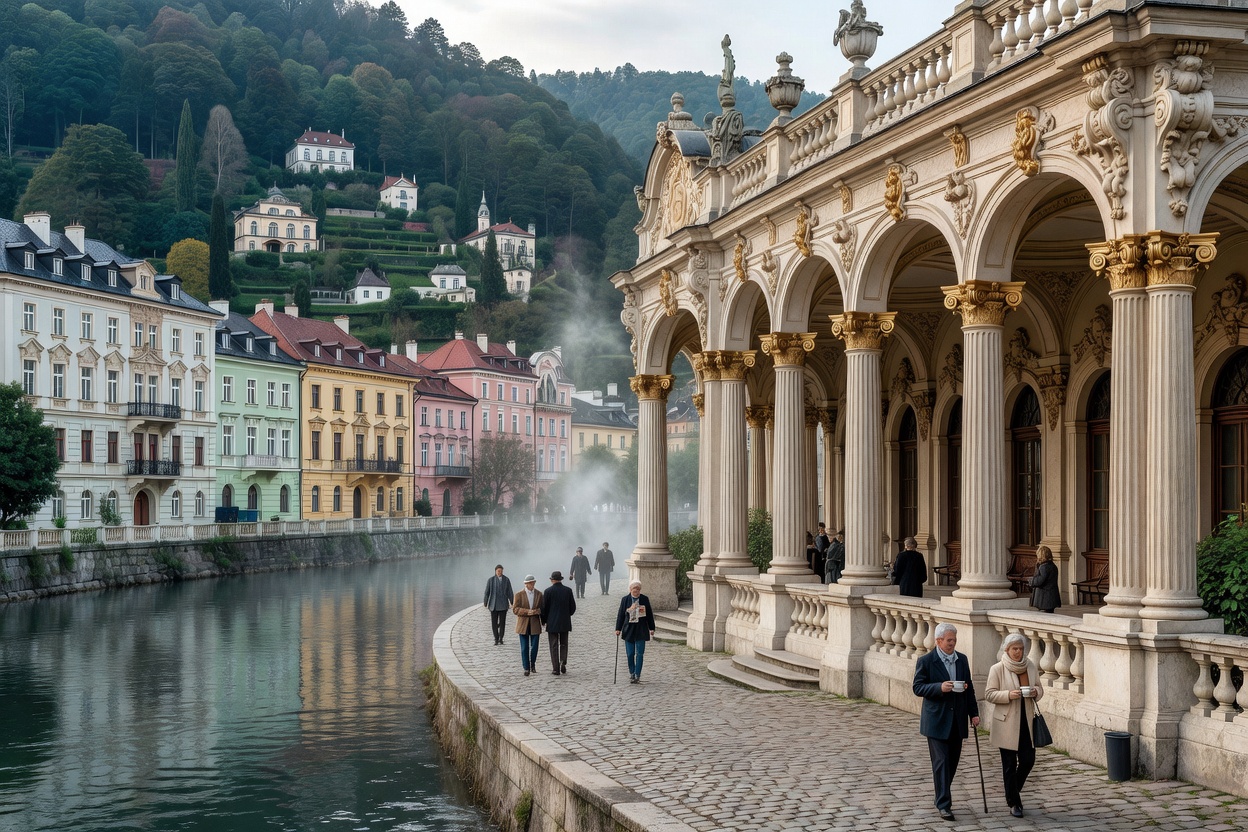
What a spa town actually is
A thermal spa town grew around a natural hot or mineral spring, and its layout still shows it. There is usually a bathhouse or a set of them at the centre, a colonnade or promenade for walking between drinking fountains, a large building — the German word Kurhaus is used across much of Central Europe — for concerts and gatherings, and a ring of hotels and villas around it all. The historic idea of the Kur, or cure, was a stay of some weeks combining bathing, drinking prescribed waters, walks and rest under medical supervision. Modern visits are far shorter, but the infrastructure built for the long version is what makes these towns so pleasant.
Eleven of these towns are inscribed together on UNESCO's World Heritage List as The Great Spa Towns of Europe: Baden bei Wien, Spa, Františkovy Lázně, Karlovy Vary, Mariánské Lázně, Vichy, Bad Ems, Baden-Baden, Bad Kissingen, Montecatini Terme and the City of Bath. The list is a useful starting point precisely because it was drawn up on architectural and historical grounds rather than on hotel quality, so it does not tell you where to sleep — only where the tradition is deepest.
Public bath or hotel spa?
This is the central trade-off in a thermal town and it has no universal answer. The great public baths — Friedrichsbad and Caracalla in Baden-Baden, the historic bathhouses of Budapest, the modern complex at Bath that draws on the city's hot spring — are usually the best water in town, are open to anyone with a ticket and carry the full weight of the place's history. The cost is that they are shared with the whole town, that opening hours are fixed, and that some sessions are crowded.
A hotel with its own thermal supply offers the reverse: privacy, unlimited access and the ability to bathe at seven in the morning in a dressing gown. Not every hotel that calls itself thermal actually pipes spring water into its pools, and the honest ones will tell you which pools are spring-fed and which are heated municipal water. If the hotel cannot answer that question clearly, assume the latter. Where a town's springs are controlled by a public body, hotel access is often by arrangement or by a short walk, and a hotel that includes bath entry in the rate is worth more than one that merely stands near the bathhouse.
Region by region
Germany and Austria
Baden-Baden is the archetype: a wealthy resort town in the Black Forest with two contrasting bathhouses, one a nineteenth-century Roman-Irish circuit that is textile-free and follows a fixed sequence of rooms, the other a large modern complex with swimwear. Bad Ems on the Lahn and Bad Kissingen in Bavaria are quieter and more medically inclined; Baden bei Wien is a short train journey from Vienna and rewards a day trip as much as a stay. Across the region, "Bad" in a town name signals a recognised spa and a tradition of treating the water seriously.
The Bohemian triangle
Karlovy Vary, Mariánské Lázně and Františkovy Lázně in the west of the Czech Republic form a cluster where drinking the water is as important as bathing in it. Karlovy Vary's hot spring, the Vřídlo, erupts as a geyser inside its own hall, and visitors walk the colonnades sipping from spouted porcelain cups. Whether the drinking cure does what its nineteenth-century proponents claimed is contested and outside the scope of this guide; what is not in doubt is that these towns offer some of the most intact spa architecture in Europe, and that hotels here still commonly sell multi-day treatment stays alongside ordinary rooms.
Budapest
Budapest is unusual: a capital city that is also a spa town, with Ottoman-era bathhouses such as Rudas and Király and grand nineteenth- and early-twentieth-century baths such as Széchenyi and Gellért. The practical consequence is that you can pair city breaks with serious bathing without leaving town, and that the best baths are public rather than hotel-owned. Booking a hotel near the bath you most want to use is usually a better plan than paying for a hotel spa that cannot match them.
Italy, France, Belgium and Britain
Montecatini Terme in Tuscany and Abano Terme near Padua represent two Italian strands — the drinking-water resort and the thermal mud resort — and in Abano in particular the hotels are the spas, each with its own thermal pools. Vichy in France and Spa in Belgium, which lent its name to the whole category, are more architectural than active today. In England, Bath's Roman remains and its working modern thermal complex make it the obvious choice; Harrogate's Victorian Turkish baths and Buxton's restored crescent are the other places where the tradition survives with actual water.
What to weigh
- Public baths
- Best water, fixed hours, shared
- Hotel supply
- Private, flexible, verify the source
- Town scale
- Capital city to single-street village
- Purpose
- Leisure bathing or supervised cure
The uncertainties
Two things are hard to establish from a distance. The first is whether a given hotel's thermal claims are literal; ask directly and look for a description of the spring rather than of the pool. The second is the medical dimension. Many Central European spa hotels offer physician-led programmes, and some national health systems have historically funded stays. None of that should be taken as a recommendation for any condition, and anyone considering a spa stay for health reasons should talk to their own doctor first. The pleasure of a thermal town does not depend on the medicine being right.